


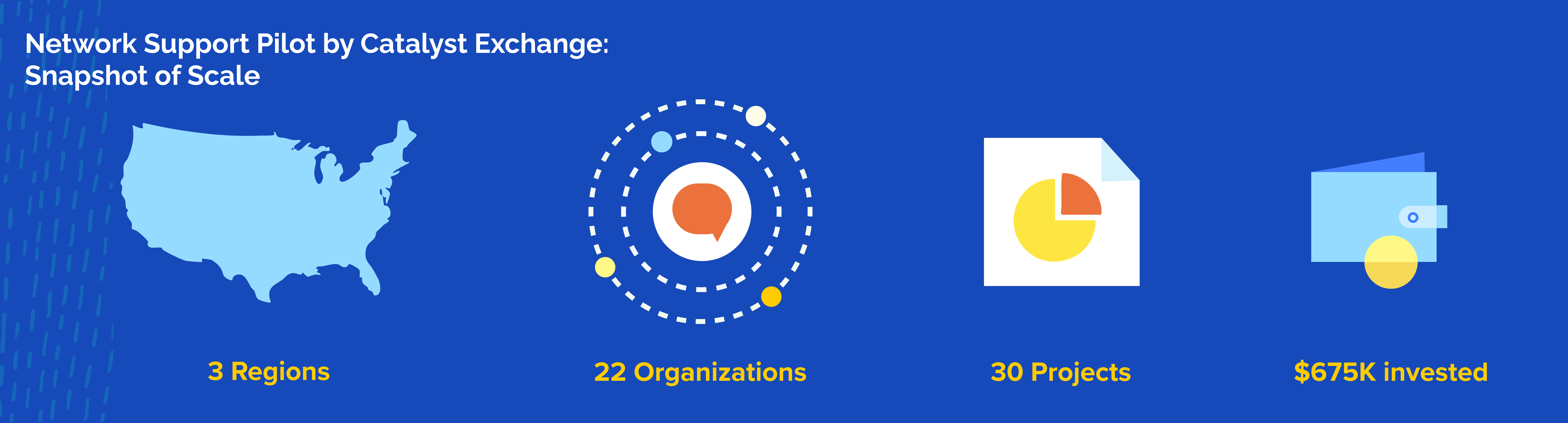
Across Eastern Kentucky, Memphis, and San Antonio, 22 community based organizations spent the past year focused on something that often gets sidelined: Not new programs. Not broadening their footprint. Their own capacity.
Through Catalyst Exchange’s Network Support Pilot, these organizations completed 30 capacity-building projects across 13 competency areas – strengthening the systems, strategies, and structures behind their mission-driven work.
We set out to test a simple idea: What happens when capacity building is designed and delivered through local networks? The answer was clear: Capacity building is highly effective when it is locally grounded, practically applied, and led by the organizations themselves.
A Model Built in Partnership
This work took place through three backbone organizations in three different regions:
- San Antonio, with UP Partnership
- Memphis, with Seeding Success
- Eastern Kentucky with AppC2C / Appalachian Cradle to Career Partnership
Each backbone identified organizations already advancing regional priorities from after-school access to wraparound services to economic mobility. Each organization then received flexible funding to complete a project tailored to its needs, from fundraising strategy to marketing, data use, and beyond.
Catalyst Exchange brought more than coordination – we brought resources, structure, and access. Through dedicated “wallets” (flexible funding allocations, see Wallets 101 for more), organizations had dollars they could deploy against their highest capacity needs, through a co-pay model that encouraged shared investment.
Our capacity advisors provided a structured approach to capacity building, working alongside organizations as thought partners to clarify, sequence, and advance their goals. And we connected organizations to a network of vetted providers with contextually relevant expertise to execute the work.
Together, this created a model that was both structured and flexible: organizations defined their own priorities; advisors helped translate those priorities into actionable plans; and funding (through a mix of direct support and co-investment) made it possible to take on work that often gets deferred.
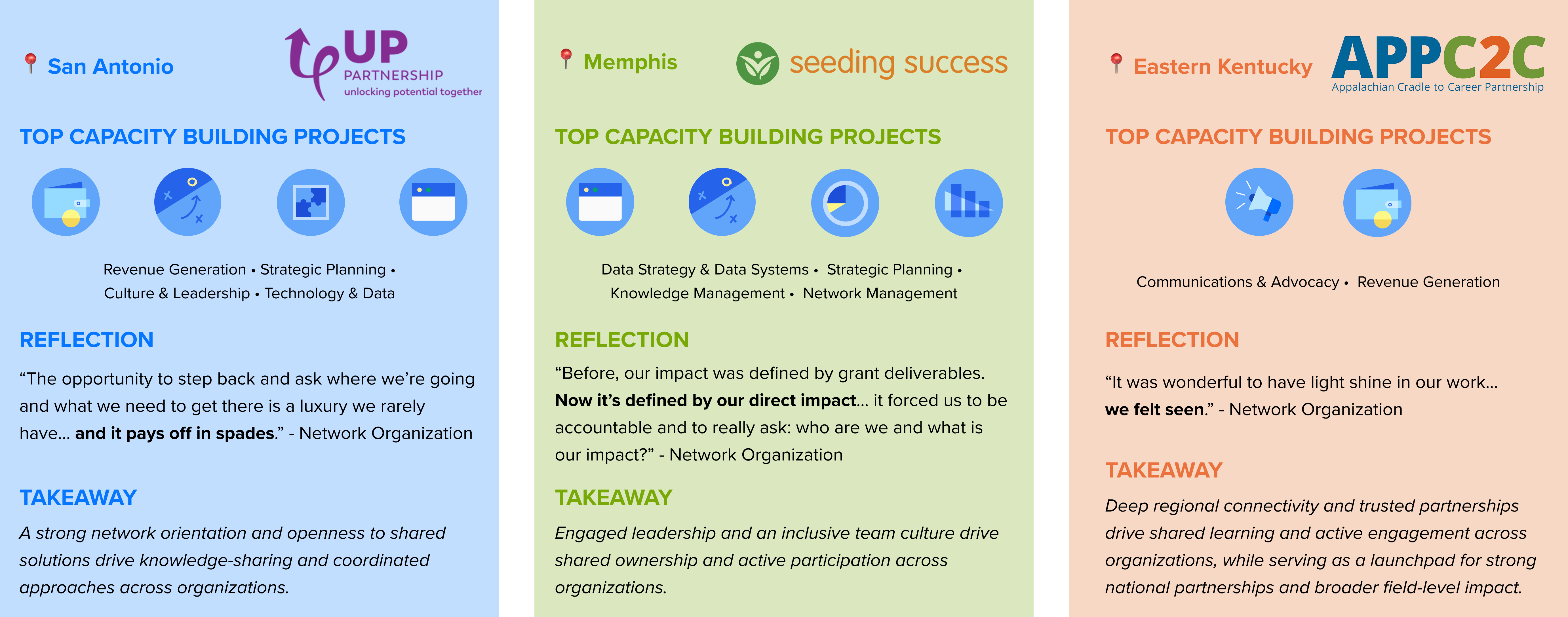
Across Each Region: What the Work Looked Like
While each site followed the same overall process, the focus and outcomes reflected local priorities and conditions.
The outcomes were both practical and lasting. Organizations across the pilot clarified strategy, built internal systems (data, fundraising, operations), developed repeatable processes, and strengthened decision-making.
But the deeper shift was how organizations approach their work.
- In San Antonio, one partner described the experience as creating “a blueprint for how to approach capacity-building moving forward.”
- In Memphis, organizations that once struggled to tell a cohesive story with their data now have clear plans and the partners to execute them.
- In Eastern Kentucky, partners named something just as important: the space to step back and focus. “We’re grateful to breathe a little bit and let someone else guide the work.”
What We Learned
Progress in one area unlocks others
Many organizations began with a single goal: strategic planning, fundraising, or improving data systems. What emerged was more interconnected.
“When you really start diving into the work… everything kind of ties together.”
Capacity building exposes how deeply linked these functions are and how progress in one area unlocks others.
- Data projects strengthened collaboration across networks
- Fundraising strategies reshaped internal team structures
- Communications work clarified organizational identity
One partner summed it up simply: “Capacity building is a team sport.”
Co-pays increase engagement, but also create barriers to access
The pilot also surfaced a consistent tension. Organizations clearly need capacity building and often struggle to access it.
- Where participation required a financial co-pay, fewer organizations enrolled
- Where funding barriers were removed, participation reached full capacity
At the same time, having financial investment across all models increased engagement and follow-through.
The key takeaway: Demand is high. Access is uneven. And despite its importance, systems-focused work (like data, strategy, and operations) remains harder to fund than programmatic efforts.
Place matters
A defining feature of this pilot was its place-based approach. Organizations didn’t just receive support, they worked with people who understood their context. Just as importantly, Catalyst deepened its own understanding of each place through site visits, close partnerships with the backbone organizations, and ongoing relationship-building with partners.
Working cohort style within the same regions meant that organizations were often navigating similar funding streams, policy landscapes, and community dynamics. That proximity created a richer, shared picture of each local ecosystem. It allowed our team’s support to be more responsive, personal, and grounded in the realities organizations were facing.
Across regions, the process and approach were tailored to reflect local realities. This meant engaging providers from each region, drawing on deep knowledge of regional policies and systems, and thoughtfully balancing insider perspective with outside expertise. Rather than applying a one-size-fits-all model, support was adapted to align with the unique dynamics, relationships, and needs present in each community.
One organization realized their public-facing language didn’t reflect how they actually showed up in their community. With support, they moved from an institutional voice to one grounded in “neighborliness”, more aligned with their role on the ground.
This shift doesn’t happen in abstraction. It happens when capacity building is rooted in place and when those offering support are learning alongside the communities they serve.
Networks amplify impact
Because this work was embedded in regional networks, the impact extended beyond individual organizations. Backbones consistently emphasized that as each partner grew stronger, the broader ecosystem strengthened with them, creating a more connected, resilient web of support for young people and families.
- In Memphis, the More for Memphis mission with young people was advanced.
- In San Antonio, organizations were able to work towards their goals of expanding access to high-quality after-school programming through the Excel Beyond the Bell initiative.
- In Eastern Kentucky, organizations were supported with system transformation for stronger place-based strategic work to take place.
Backbones made this possible not just as connectors, but as translators and aligners of local priorities. Capacity building became more relevant and more durable because it was networked.
Closeout with the Community Organizations
Each region closed the pilot with an in-person gathering, bringing partners together to reflect on what changed and what comes next.
Watch this recap video from San Antonio's event with UP Partnership partners.
Why This Matters & What’s Next
Across all three regions, several patterns emerged:
- Demand for capacity building is high at the local level
- Organizations can effectively prioritize their needs when given space and support
- Systems-focused work drives long-term impact
- Local partnerships increase relevance and effectiveness
- Structured support accelerates progress
This pilot offers a clear signal for the field. Too often, capacity building is treated as secondary to program delivery. But this work shows the opposite. When organizations strengthen their internal systems, their ability to deliver impact expands with it.
It also reinforces a broader shift, toward capacity support that is embedded in local ecosystems, aligned with shared regional goals, and designed around real operating conditions.
This pilot was designed to test and learn. It confirmed that when organizations are trusted to define their needs and resourced to address them, they build systems that last.
Catalyst Exchange will continue this work with new sites later this year, building on what was learned across these three regions.
One partner said it best: “It felt like this was just the beginning.”
%20White.jpeg)